
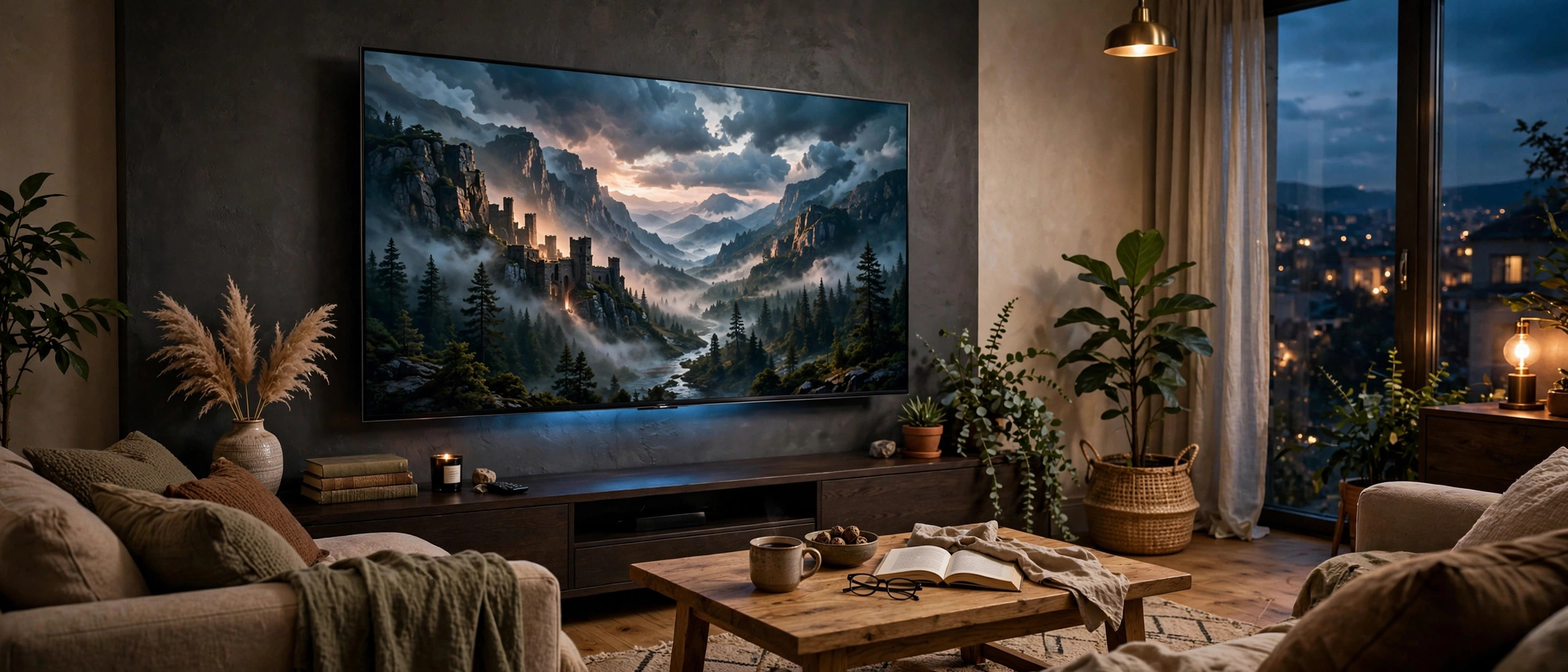
Asking lcd vs oled tv which is better is the right question in 2026 — but the honest answer is “it depends on how you watch.” LCD (LED), OLED, and AMOLED panels all produce beautiful pictures today, yet they differ fundamentally in contrast, brightness, burn-in risk, and price. This guide compares them head-to-head with a clear table, then tells you exactly which to buy for movies, gaming, sports, and tight budgets.
LCD vs OLED vs AMOLED TV: How Each Technology Works
The core of the lcd vs oled tv which is better debate is how each panel creates light. LCD TVs (marketed as “LED TVs”) use a liquid-crystal layer lit from behind by LEDs — the crystals block light to create dark areas, but some light always leaks through. OLED TVs have pixels that produce their own light and switch off completely for true black. AMOLED is Samsung’s brand of OLED using an active-matrix backplane — in TVs it appears mainly in Samsung’s QD-OLED models, which combine OLED’s perfect blacks with quantum-dot color. For TV shopping, think of it as LCD vs OLED, with QD-OLED/AMOLED as OLED’s brighter premium variant.
Comparison Table: LCD vs OLED vs AMOLED TV
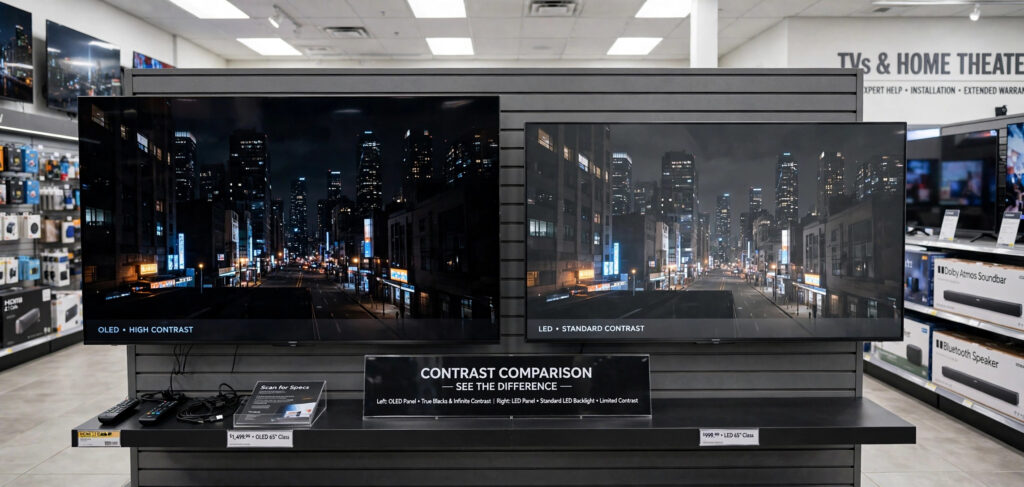
LCD vs OLED TV: which is better for your living room? The table below answers it at a glance.
| Factor | LCD (LED) | OLED | AMOLED / QD-OLED | ||
|---|---|---|---|---|---|
| Black levels / contrast | Good (grayish blacks); excellent on Mini-LED | Perfect blacks, infinite contrast | Perfect blacks, infinite contrast | ||
| Peak brightness | Highest — best for bright rooms | Good, improving yearly | Very high — near LCD levels | ||
| Burn-in risk | None | Low but real with static images | Low but real with static images | ||
| Viewing angles | Narrow on basic VA panels; wide on IPS | Excellent from any angle | Excellent from any angle | ||
| Response time (gaming) | Good (5–15 ms) | Superb (~0.1 ms) | Superb (~0.1 ms) | ||
| Lifespan | 60,000–100,000 hours | 30,000–50,000+ hours | 30,000–50,000+ hours | ||
| Price (55″ in 2026) | $350–$900 | $900–$1,600 | $1,200–$2,200 |
LCD vs OLED TV Which Is Better for Movies?
For a dark home theater, OLED wins decisively — perfect blacks make night scenes look three-dimensional in a way no LCD can match, and the infinite contrast flatters every film. This is the use case OLED was born for. However, if your living room has big windows and you watch mostly during the day, a bright Mini-LED LCD can actually look better because it overpowers reflections. Rule of thumb: dark room = OLED, bright room = high-end LCD.
What About AMOLED for Movies?
QD-OLED/AMOLED panels give you OLED’s perfect blacks plus higher brightness and richer color volume — the best of both worlds for movies. The catch is price: in 2026 you pay a 30–50 percent premium over standard OLED. Worth it for dedicated movie lovers with the budget and a light-controlled room; overkill for casual viewers.
LCD vs OLED TV Which Is Better for Gaming?
Gamers should lean OLED. The ~0.1 ms response time eliminates motion blur, and modern OLED TVs support 120 Hz, VRR, ALLM, and HDMI 2.1 across the board — features that cost extra on many LCDs. If you are building a retro gaming setup, the display matters enormously; see our guide on building a retro gaming console with Raspberry Pi to pair with your new screen. The one caveat: static HUD elements can, over thousands of hours, contribute to burn-in — vary your content and enable the TV’s pixel-shift features. Competitive players who game 8+ hours daily on the same title may prefer a Mini-LED LCD for total peace of mind.
Which Is Better for Sports, News, and Bright Rooms?
Bright LCD wins here. Sports and news involve bright, static-heavy content (score bugs, tickers, channel logos) in often well-lit rooms — exactly the scenario where LCD’s high brightness and zero burn-in risk shine. A quality Mini-LED LCD with a 120 Hz panel is the sensible, durable pick for the family living room TV that is on all day.
Why 120 Hz Matters for Sports
Whatever panel type you choose, insist on a native 120 Hz panel if you watch a lot of sports. Fast camera pans at 60 Hz judder visibly; 120 Hz with good motion processing keeps the ball smooth and readable. This matters more for sports enjoyment than the LCD vs OLED distinction itself — a 120 Hz LCD beats a 60 Hz OLED for football every time. Check the spec sheet carefully: some budget TVs advertise “motion rate 120” while the panel is actually 60 Hz.
Mini-LED: The LCD Upgrade Worth Knowing About
If the lcd vs oled tv which is better debate feels close, Mini-LED is why. Standard LCDs use dozens of backlight zones; Mini-LED packs thousands of tiny LEDs into hundreds or thousands of dimming zones, dramatically cutting the light-bleed that causes grayish blacks. A good Mini-LED TV in 2026 delivers contrast that embarrasses old LCDs, brightness that beats OLED, and zero burn-in risk — at prices well below OLED. For bright living rooms and mixed family viewing, Mini-LED is arguably the best all-rounder on the market right now, and it is the technology most likely to steal OLED’s thunder over the next few years.
Burn-In Explained: Should You Worry in 2026?
In the LCD vs OLED TV which is better debate, burn-in — permanent image retention from static elements — is the main knock against OLED. The reality in 2026: for varied content (movies, shows, mixed gaming), it is essentially a non-issue thanks to pixel shifting, logo dimming, and improved panel materials. It remains a genuine consideration only for extreme use: the same news channel 10 hours a day, or a single game’s static HUD for years. Manufacturers now include multi-year burn-in warranties on many models, which tells you how confident they have become. Practical prevention is simple: vary your content, keep brightness at sensible levels rather than maximum, enable the TV’s built-in pixel-shift and screen-move features, and use the auto-dimming for static logos if offered.
Which TV Should You Buy? Decision Guide
Use this shortlist to settle LCD vs OLED TV which is better for your specific situation:
- Movie lover, dark room: OLED — nothing else comes close for cinema.
- Bright living room / all-day family TV: Mini-LED LCD — bright, tough, great value.
- Serious gamer: OLED (or QD-OLED if budget allows) — unmatched motion clarity.
- Best picture money can buy: QD-OLED/AMOLED flagship.
- Tight budget: a good mid-range LCD — in 2026 even $500 buys an excellent 55-inch picture.
One more tip for movie nights: ambiance matters as much as the panel. Automating your room lighting to dim when the film starts is a classic starter project — our Raspberry Pi home automation guide walks through exactly that kind of setup.
Frequently Asked Questions
Is OLED worth the extra money over LCD in 2026?
If you watch movies in a dim room or game seriously, yes — the contrast difference is visible the moment you see them side by side. For bright-room daytime viewing of news and sports, a good LCD gives you 90 percent of the enjoyment for half the price.
How long do OLED TVs last?
Modern OLED panels are rated for 30,000–50,000+ hours to half-brightness — roughly 10+ years at 8 hours a day. They will not “wear out” under normal mixed viewing; only extreme static-content abuse meaningfully shortens life.
What is the difference between OLED and AMOLED in TVs?
AMOLED is a type of OLED using an active-matrix backplane. In the TV market, “AMOLED” effectively means Samsung’s QD-OLED panels, which add a quantum-dot layer for higher brightness and color volume than standard (WOLED) panels. Both have perfect blacks; QD-OLED is brighter and pricier.
Do I need HDMI 2.1 on my new TV?
For PS5/Xbox Series gaming at 4K/120 Hz, yes — it is essential. For movies and streaming, no current content needs it, but buying HDMI 2.1 anyway is cheap future-proofing since most 2026 mid-range and up TVs include it.
What size TV should I buy?
The modern rule: viewing distance in inches divided by 1.5–2 gives a good screen size. For a 3 m (10 ft) sofa distance, 65–75 inches is ideal. In 2026, going bigger within your budget almost always beats buying a smaller premium panel — size impresses more than marginal picture gains.
Is 8K worth it yet?
Not in 2026. There is virtually no native 8K content, and at normal viewing distances the human eye cannot resolve the difference over 4K on screens under 75 inches. Put the 8K premium toward a larger 4K OLED or Mini-LED instead — you will see that difference every single day, in every single show.
Conclusion
So, lcd vs oled tv which is better? For cinematic contrast and gaming, OLED (or its brighter AMOLED/QD-OLED sibling) is the clear winner. For bright rooms, all-day durability, and value, LCD — especially Mini-LED — remains the smart buy. Match the panel to your room and your habits using the decision guide above, buy the biggest quality screen your budget allows, and you will love the result for a decade. And remember: the best TV is the one calibrated to your room — spend 15 minutes with the picture settings (or a free calibration video) after unboxing, because even a flagship panel looks mediocre on torch-mode defaults. Take notes while you shop, compare in person where possible, and trust your own eyes.