

The benefits of buying electric scooter models go far beyond looking cool on the commute. In 2026, e-scooters have matured from novelty gadgets into serious urban transport: longer ranges, better build quality, and prices that undercut almost every alternative. Whether you are dodging traffic, cutting fuel costs, or shrinking your carbon footprint, here are 10 well-explained advantages — plus practical buying tips at the end.
10 Benefits of Buying Electric Scooter Models
1. Dramatically Lower Running Costs
The number one among the benefits of buying electric scooter models is cost. Charging a typical e-scooter costs a few cents per full charge — often under $0.50 — and delivers 25–40 km of range. Compare that with petrol, parking fees, and public transport fares, and most commuters save hundreds per year. There are no oil changes, no spark plugs, and brake pads last far longer thanks to regenerative braking.
2. Zero Tailpipe Emissions
Electric scooters produce no exhaust fumes, which matters enormously in congested cities where air quality is a genuine health issue. Even accounting for electricity generation, an e-scooter’s lifetime carbon footprint is a small fraction of a petrol scooter’s or car’s. If your grid includes renewables, the advantage grows every year.
3. Beat the Traffic
In rush hour, a 10 km car journey can take 40 minutes; on an e-scooter using bike lanes and side streets, it is often 20. Scooters slip through congestion that traps cars and buses alike, and your arrival time becomes predictable — no more guessing how bad traffic will be today.
4. Parking Becomes a Non-Issue
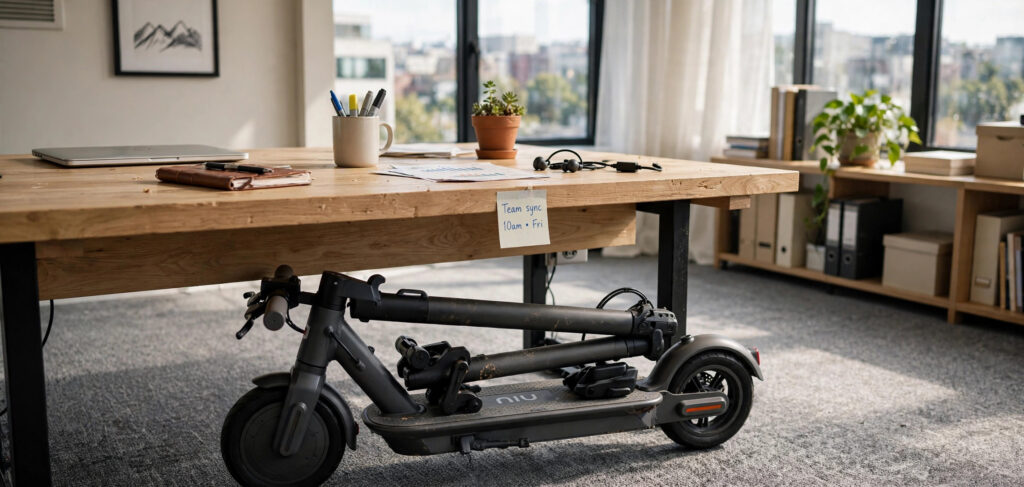
Forget circling for parking spots or paying garage fees. Most e-scooters fold in seconds and fit under a desk, in a closet, or in a car boot. In dense cities where parking costs rival fuel costs, this alone can justify the purchase.
5. Whisper-Quiet Operation
Electric motors are nearly silent compared to petrol engines. You can leave early or come home late without waking the neighborhood, hold a conversation while riding alongside someone, and enjoy a far less stressful commute without engine drone.
6. Minimal Maintenance
With no engine oil, filters, or complex transmission, e-scooter maintenance is mostly tires, brakes, and the occasional firmware update — another of the quiet benefits of buying electric scooter ownership. Annual maintenance costs are typically under $50 for most riders — compare that with hundreds for a petrol two-wheeler’s servicing schedule.
7. Instant Torque and Fun Factor
Electric motors deliver maximum torque from zero RPM, so acceleration feels punchy and responsive even on modest models. Riding is genuinely enjoyable — many owners report that their “boring commute” became the best part of the day.
8. Government Incentives and Low Taxes
Many regions still offer purchase subsidies, reduced registration fees, or tax breaks for electric two-wheelers in 2026. Check your local transport authority’s website — incentives can knock 10–20 percent off the effective price, and some cities allow e-scooters in bus lanes or offer free charging points.
9. Perfect for Last-Mile Connectivity
E-scooters shine as the missing link between public transport and your final destination. Fold it, carry it onto the train, unfold at the other end — the classic last-mile problem solved. Commuters who combine scooters with metro or rail often cut total journey times dramatically.
10. Improving Range and Reliability in 2026
Early e-scooters earned a reputation for flimsy builds and optimistic range claims. The 2026 generation is different: 40–60 km real-world ranges are common in the mid-range, IPX water resistance is standard on decent models, and solid-tire or puncture-resistant options have tamed the flat-tire problem. Buying now means buying mature technology.
Electric Scooter vs Alternatives: Annual Cost Comparison
Numbers make the benefits of buying electric scooter models concrete. Here is a rough annual comparison for a 10 km daily commute:
| Transport mode | Annual fuel/energy | Annual maintenance | Parking/tickets | Total approx. |
|---|---|---|---|---|
| Electric scooter | $30–$60 | $30–$50 | $0 | $60–$110 |
| Petrol scooter | $400–$600 | $150–$250 | $0–$200 | $550–$1,050 |
| Car | $1,200–$2,000 | $400–$800 | $500–$2,000 | $2,100–$4,800 |
| Public transport | $800–$1,500 (passes) | $0 | $800–$1,500 | |
Even against public transport, the e-scooter typically pays for itself within a year — and unlike a transit pass, it is available at midnight, in the rain, exactly when you need it.
Buying Tips: Maximizing the Benefits of Buying Electric Scooter Models
The benefits of buying electric scooter ownership only materialize if you buy the right one. Key specs to compare:
- Real-world range: manufacturers quote ideal conditions; expect 60–70 percent of the claimed figure. Buy 30 percent more range than your daily need.
- Motor power: 250 W is fine for flat cities; 350–500 W handles hills and heavier riders comfortably.
- Battery: look for reputable lithium-ion cells (36 V/48 V systems), and check whether the battery is replaceable — a replaceable battery doubles the scooter’s useful life.
- Tires: 10-inch pneumatic tires give the best comfort; solid tires are puncture-proof but harsher. Suspension matters more than most buyers expect.
- Brakes: dual braking (disc + regenerative or drum) is the safety baseline; avoid single-brake budget models.
- Weight and fold: if you carry it upstairs or onto trains, every kilogram counts — aim under 15 kg for true portability.
- Water resistance: IPX5 or better for rainy climates; never ride through deep water regardless of rating.
Budget Picks for 2026
You do not need to spend a fortune to get the full benefits of buying electric scooter ownership. Budget ($300–$500): fine for short flat commutes under 8 km — expect 250 W motors, 25 km claimed range, and basic drum brakes. Mid-range ($500–$900): the sweet spot for most buyers — 350–500 W, 35–50 km real-world range, disc brakes, suspension, and IPX5 sealing. Premium ($900–$1,500+): dual motors, 60 km+ range, hydraulic brakes, and full suspension for enthusiasts and long commutes. Whatever tier you choose, buy from a brand with local spare-parts availability — a cheap scooter you cannot repair is the most expensive kind.
Research Smart Before You Buy
Use AI to speed up your comparison shopping: our guide on how to write better ChatGPT prompts shows how to get genuinely useful side-by-side spec comparisons instead of generic answers. And if you plan to sell your old scooter or bike online, clean listing photos matter — free AI background remover tools can make your photos look professional in seconds.
Who Should NOT Buy an Electric Scooter?
Honesty matters: e-scooters are not for everyone. Skip one if your commute exceeds 20 km each way (range anxiety gets old fast), your route has steep hills and you weigh over 100 kg (even 500 W motors struggle), your city bans them from roads and bike lanes (check first!), or you need to carry children or heavy cargo. Riders with balance issues should also think twice — a fall at 25 km/h is no joke. For everyone else, the benefits of buying electric scooter models outlined above make it one of the smartest urban purchases of 2026.
Frequently Asked Questions
How much does it cost to charge an electric scooter?
Typically $0.20–$0.50 per full charge depending on battery size and local electricity rates — roughly 1–2 cents per kilometer. That is about 10–20 times cheaper per kilometer than petrol, every single day.
How long do electric scooter batteries last?
Quality lithium-ion batteries last 2–4 years or 500–1,000 full charge cycles before capacity drops noticeably. Avoid storing the scooter fully charged or fully empty for long periods, and keep it out of extreme heat to maximize battery life.
Are electric scooters legal on public roads?
Rules vary widely by country and even by city: some treat them like bicycles, others require registration or restrict them to bike lanes, and a few ban them from sidewalks entirely. Always check your local regulations before riding — legality is the one thing you must verify yourself.
Can electric scooters handle rain and hills?
Light rain is fine for any IPX4+ rated scooter; avoid heavy downpours and standing water. Hills depend on motor power and rider weight — 350 W+ handles moderate inclines, while steep hills need 500 W or a model with a high-torque geared motor.
What safety gear do I need?
At minimum, a certified helmet — e-scooter falls happen at 25 km/h, and head injuries are the serious risk. Gloves, a front light for night riding, and a reflective vest are strongly recommended. Ride defensively: car drivers often misjudge scooter speed.
Should I buy new or second-hand?
Second-hand can be a bargain, but the battery is the risk: ask for the purchase date, check the range on a test ride against the claimed figure, and inspect tires and brakes carefully. If the battery is over 2 years old, factor a replacement ($100–$250) into the price — at that point, new often makes more sense.
Conclusion
The benefits of buying electric scooter models stack up fast: tiny running costs, zero emissions, traffic-beating convenience, easy parking, near-silent operation, and minimal maintenance — all on technology that has genuinely matured by 2026. If your daily trips are under 20 km and your city allows them, an e-scooter is one of the highest-value purchases you can make this year. Compare real-world range and brakes carefully, check your local laws, and join the quiet revolution.