

This air conditioner buying guide will save you from the most expensive mistake AC shoppers make: buying the wrong size. An oversized unit short-cycles, wastes electricity, and leaves your room clammy; an undersized one runs nonstop and still cannot cool the space. Getting the size right — measured in BTU or kW — matters more than the brand name on the box. This 2026 guide walks you through sizing, energy ratings, inverter technology, and everything else you need to choose with confidence.
Air Conditioner Buying Guide: Start With the Right Size
Cooling capacity is the foundation of this air conditioner buying guide because every other decision depends on it. Capacity is measured in BTU per hour (British Thermal Units) or kilowatts (kW); 1 kW equals roughly 3,412 BTU/h. The right capacity depends mainly on room size, but ceiling height, sunlight exposure, insulation, and climate all shift the numbers.
BTU/kW Sizing Table by Room Size
Use this table as your starting point — it is the most-referenced chart in this air conditioner buying guide. These figures assume standard 2.4–2.7 m ceilings and average insulation:
| Room size | BTU/h needed | kW needed |
|---|---|---|
| Up to 15 m² (small bedroom) | 9,000 BTU | 2.6 kW |
| 15–25 m² (bedroom / small living room) | 12,000 BTU | 3.5 kW |
| 25–35 m² (large living room) | 18,000 BTU | 5.3 kW |
| 35–50 m² (open-plan area) | 24,000 BTU | 7.0 kW |
| 50–70 m² (large open space) | 30,000–36,000 BTU | 8.8–10.5 kW |
Adjust upward by 10–20 percent if the room gets strong afternoon sun, has high ceilings, poor insulation, or houses heat-producing equipment. Adjust downward slightly for shaded, well-insulated rooms. When in doubt, a professional heat-load calculation is worth the small fee — guessing wrong costs far more over the unit’s lifetime.
Why Oversizing Is Just as Bad as Undersizing
Many shoppers assume bigger is better. It is not. An oversized AC cools the air so quickly that it shuts off before removing humidity, leaving rooms cold but damp — the classic recipe for mold and that clammy feeling. Short cycling also wears out the compressor faster through constant start-stop stress. Right-sizing is the single highest-impact decision in any air conditioner buying guide.
Inverter vs Non-Inverter: Which Technology to Choose
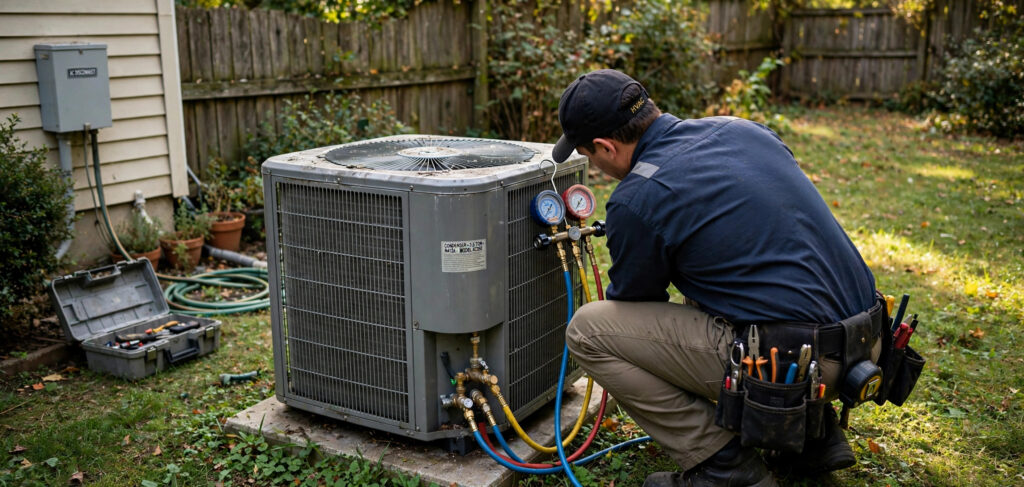
This is the second big decision. A non-inverter (fixed-speed) compressor runs at full power or not at all, cycling on and off to hold temperature. An inverter compressor varies its speed continuously, running gently most of the time and ramping up only when needed.
Advantages of Inverter ACs
- 30–50% lower electricity bills in typical use, because the compressor avoids energy-hungry restarts.
- Quieter operation — no loud on/off cycling, especially noticeable at night.
- More stable temperatures with fewer swings, and better dehumidification.
- Longer compressor life thanks to gentler operation.
When Non-Inverter Still Makes Sense
Non-inverter units cost less upfront and can be reasonable for rooms used only a few hours a day, or in areas with very cheap electricity. But for most buyers in 2026, the inverter premium (typically 15–25 percent more) pays for itself within 2–3 cooling seasons through lower bills. If you run the AC daily, inverter is the clear winner.
Energy Ratings Explained: What the Stars and Labels Mean
No air conditioner buying guide is complete without decoding efficiency labels, because the sticker price is only half the cost — the other half is a decade of electricity bills.
Understanding EER, SEER, and Star Ratings
Efficiency is measured as cooling output divided by electricity input. Look for the seasonal rating (often labeled ISEER in India or SEER in the US/EU), which reflects real-world performance across a season rather than a single lab condition. A 5-star or A+++ rated 1.5-ton inverter AC can consume roughly half the electricity of a 3-star non-inverter of the same capacity. Over 10 years, that difference can exceed the price of the unit itself.
Refrigerant Types: R32 vs R410A
In 2026, prefer R32 refrigerant: it has roughly one-third the global warming potential of the older R410A, needs less charge per unit, and is slightly more efficient. R32 units are now mainstream and similarly priced. Avoid any new unit still using phased-out refrigerants.
Split vs Window vs Portable: Choosing the Right Type
- Split AC: Quietest and most efficient; the noisy compressor sits outside. Best for bedrooms and living rooms. Needs professional installation.
- Window AC: Cheaper and simpler to install, but noisier and less efficient. Good for rented spaces where you cannot drill for a split.
- Portable AC: No installation at all, but the least efficient and noisiest option, and the exhaust hose radiates heat back into the room. Buy only if split and window are both impossible.
Air Conditioner Buying Guide: Features Worth Paying For
Worth it: Wi-Fi/smart control (genuinely useful for pre-cooling and scheduling — and if you like DIY, you can go further with projects like our Raspberry Pi home automation guide), sleep mode, auto-clean/anti-bacterial filters, copper condensers (more durable and repairable than aluminum), and a good warranty on the compressor (10 years is now common).
Skip: Overhyped “AI” modes that just adjust the fan, built-in air purifiers that cannot match a dedicated purifier, and ultra-low-temperature cooling claims you will never use. Put that money toward a higher star rating instead. Smart ACs talk to their apps over your home network — our plain-English what an API is guide explains how that communication works behind the scenes.
Installation and Placement Tips
Even the best unit from any air conditioner buying guide performs badly if installed poorly. Mount the indoor unit high on a wall away from direct heat sources, with unobstructed airflow. The outdoor unit needs shade and at least 30 cm of clearance on all sides — a condenser baking in direct sun works measurably harder. Insist on proper vacuuming of the refrigerant lines during installation (skipping this step is a common cause of early compressor failure), and make sure the condensate drain slopes away from the wall. Installation quality is the sleeper factor in every air conditioner buying guide.
How Much Does an Air Conditioner Cost in 2026?
Budget planning is part of every realistic air conditioner buying guide. Indicative 2026 prices for a 1.5-ton (18,000 BTU) split AC: budget non-inverter models start around $350–$450, mid-range 3-star inverter units run $500–$700, and premium 5-star inverter models with Wi-Fi cost $750–$1,100. Window units of the same capacity are typically $100–$200 cheaper, while portable units sit in the $400–$600 range but cost more to run.
Do not forget installation ($100–$250 for a standard split install, more for long piping runs) and running costs. A 1.5-ton 5-star inverter AC running 8 hours a day typically consumes 4–6 units of electricity daily; at average tariffs that is roughly $25–$45 per month in the cooling season, versus $45–$80 for an old 3-star non-inverter. When comparing two models, estimate 10 years of running costs — the “expensive” efficient model is very often the cheaper one overall.
Frequently Asked Questions
What size AC do I need for a 20 square metre room?
A 12,000 BTU (3.5 kW) unit is the standard recommendation for 15–25 m². Go up to 18,000 BTU if the room has large west-facing windows, high ceilings, or poor insulation.
Is a 5-star AC worth the extra cost over a 3-star?
Usually yes. The price gap is typically modest, while a 5-star inverter unit can save 30–40 percent on cooling electricity. Most households recover the difference within 2–3 years, then keep saving for the rest of the unit’s 10–15 year life.
How often should an air conditioner be serviced?
Clean the filters yourself every 2–4 weeks during the cooling season, and book a professional deep service once a year before summer — coil cleaning, drain check, and refrigerant pressure verification. Skipped servicing is the top cause of weak cooling and compressor failure.
Can I install a split AC myself?
No — split AC installation requires handling refrigerant, vacuuming lines, and electrical work that legally requires certification in most countries. DIY installation voids the warranty and risks dangerous refrigerant leaks. Window and portable units are the DIY-friendly options.
What is the ideal temperature setting for efficiency?
24–26°C is the sweet spot: each degree lower increases consumption by roughly 6–8 percent. Using sleep mode or a timer to avoid overcooling at night saves more than any feature on the spec sheet.
Should I replace my old AC or keep repairing it?
If your unit is over 10–12 years old, uses phased-out refrigerant, and needs a major repair (compressor or coil), replacement almost always wins — a modern 5-star inverter can halve the running costs of a 15-year-old 2-star unit, and many governments and utilities still offer rebates for upgrading to high-efficiency models. For minor repairs on units under 8 years old, repair is usually the economical choice.
Conclusion
A smart purchase comes down to the priorities in this air conditioner buying guide: size the unit correctly using the room-size table, choose inverter technology for daily use, buy the highest star rating your budget allows, prefer R32 refrigerant and copper condensers, and invest in professional installation. Do those five things and you will get a decade or more of quiet, efficient cooling — and the lowest total cost of ownership, not just the lowest price on the shelf. Bookmark this air conditioner buying guide and run through the checklist once more before you hand over your money; ten minutes of verification now prevents ten years of regret.